In 2025 a local lawyer’s magazine put out a call for submissions on the topic of “finding your way.” I put together this essay and submitted it; although the organization had been interested when I queried, they eventually decided the piece “wasn’t a good fit.” I suspect that’s because I’ve mildly criticized legal AI and legal AI companies are reliable purchasers of advertising in lawyer’s trade magazines. I thought about trying to rework it to submit elsewhere, but nah. Here it is. For free. You don’t even have to be a member of the bar to read it.
Lawyers and judges are using artificial intelligence to write things. Not all of us are using AI well, if the many reports of hallucinated legal citations showing up in motions and two recent judicial opinions in New Jersey are to be believed. But many of us are using it. I am not. I don’t even know where to find AI particularly. I don’t think I’m a Luddite. (I am a bit Lollard-y. Sometimes I call myself an anchorite. Obscure historical movements can be fun!) I get that AI is sometimes faster, cheaper, and more efficient, especially for some kinds of legal work. I know that we are all busy and clients are watching their budgets. I just don’t want AI getting in between me and the things I want to write. It has taken me some time to develop this relationship with language (the longest lasting one of my life excepting my parents) and I’m not ceding my words to a server farm just yet. I believe that I bring something to a motion, a brief, an essay, or, yes, a poem, that AI cannot and that something is the whole of my experience beyond the parameters of the task I am doing. AI can steal my creative work for large language models (and I think it has) but we don’t yet have a way of uploading minds to the cloud.
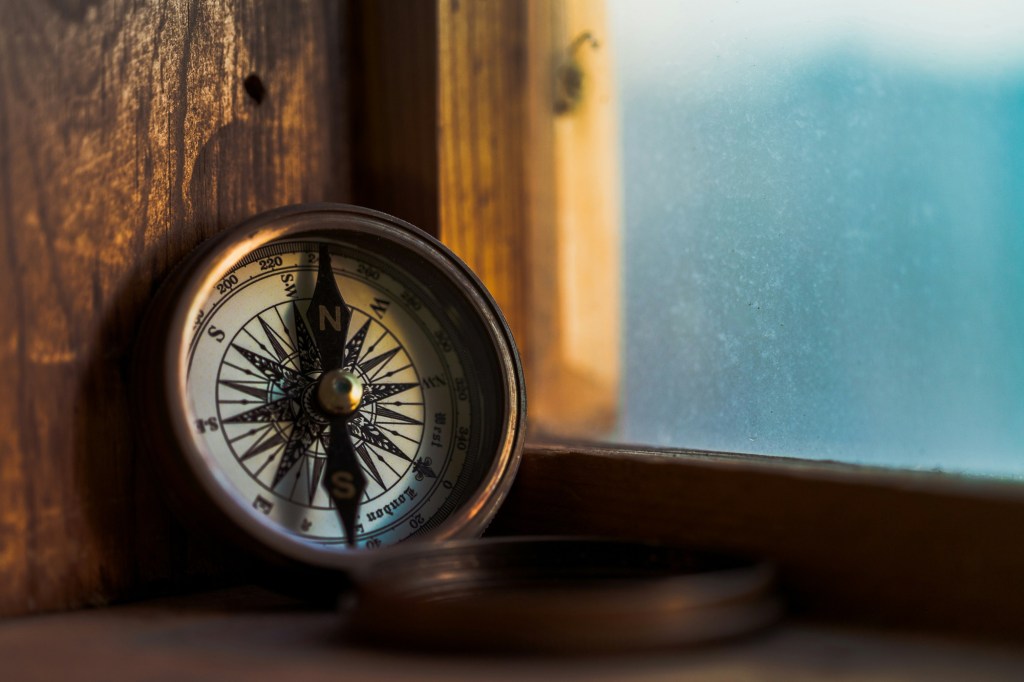
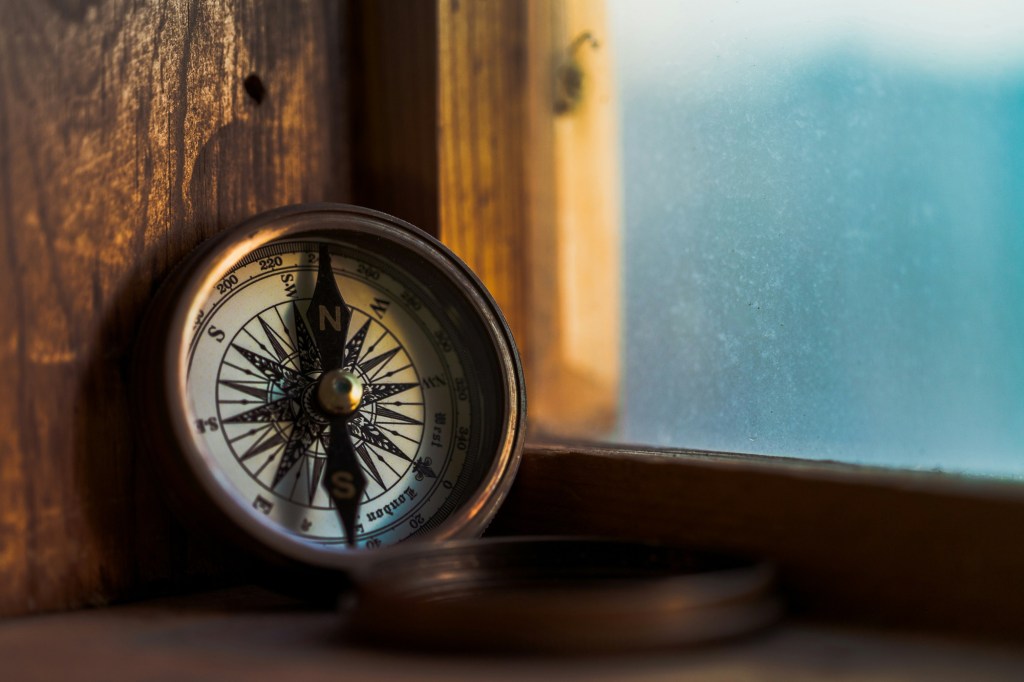
I am to write about compasses, and not only compasses but also finding them. I am to consider not only finding compasses, but finding personal ones. First I want to say that I think this central metaphor is imprecise because a compass is never personal, at least not with respect to function, which is the raison d’être of compasses. A compass points to north. From wherever you are, you can know where north is, which might be useful to you if you need to know where north is. However, a compass will never explain specifically where you ought to go or how you ought to get there. A compass has no inherent meaning other than the meaning its user gives it. If we think of a compass as a system for wayfinding – as I think we should, at least for the moment – then we must conclude that this system is incomplete. Something from outside the system is necessary if it is to have any meaning. Wayfinding should be distinguished from waymaking.
In 2013 I witnessed a shooting in the lobby of a Wilmington courthouse. I’ve written about the experience elsewhere and I find the details too exhausting to write down again so I won’t repeat them here. I only bring it up so I can tell you that I decided, within a few years after, that I would be a happier, healthier person if I spent less time in courthouses. This was a momentous decision because I was (still am? in my way) a litigator. Litigation occurs in courthouses. I went looking for a roundabout way to a destination I wasn’t sure existed. I thought maybe I could be a teacher. I am also (stay with me here) a poet. I was a poet before I was a lawyer and I had a vague sense that poeting might save me. Perhaps my words would take me somewhere and I couldn’t think of anything else to try so I started walking in the general direction of Poet City. I wrote things, some of them pretty good. I spent a few weeks at Kenyon College and then at Bread Loaf, a place so venerable and sacred to my kind that attendees make an annual pilgrimage to Robert Frost’s cabin, which is nearby. I kept writing things. Sometimes law crept into what I was working on. I furiously tried to buff it out but it always came back.
I won a fellowship to attend the graduate creative writing program at Hollins University in Virginia. For two years I wandered around on blades of grass trod before me by folks like Annie Dillard, Kiran Desai, and Natasha Tretheway. I wrote poems, stories (terrible stories, I wish I could write fiction well), and essays. I taught undergraduates how to write poems, stories, and essays. The pandemic happened. The bottom fell out of the teaching market. It was time for me to be a lawyer again so I was and am. My first book was a finalist for a couple of literary prizes. I wrote motions and oppositions. I finished a second book to be released in 2026. I am still writing motions and oppositions and now also the occasional appellate brief. I am good with this. I’m in my office all the time now, hence my joke about being an anchorite. I think my motions and briefs are better for my experiences since 2013. For one thing and for good or ill I am no longer tethered to IRAC. I think – and this feels very strange to write, but it is true – that my motions and briefs are better for my experience of the shooting. I bring to my work now a familiarity with sudden crisis, with the awful momentous thing that, once done, cannot be undone. That familiarity is always there, an undercurrent, whether it has to be or not. Clients who are struggling with their own happenings find in me a fellow traveler.
While I was in grad school I wrote an essay interpreting Anne Carson’s “The Glass Essay” via Gödel’s Incompleteness Theorems. This project was exactly as pretentious and embarrassing as it sounds. The executive summary of the theorems is that no formal, complex system can prove itself true by itself. Math is one kind of formal system. In the early twentieth century analytic philosophers like David Hilbert were trying to develop logical proofs that would contain everything that can be known about math. The genius Kurt Gödel was interested in this possibility, too, but he wound up doing something much bigger by disproving it. Math does not provide the tools for establishing that math is true. This principle applies to all kinds of complex systems. Daubert actually comes to mind, because we no longer permit the experts to prove reliability by their own bootstraps. I argued in my paper that, in Carson’s work, the soul is a system proved through the pain of loving what has and must be lost. You can argue that faith is a similar kind of system, or ethics or physics or law.
“Essay” derives from the French word “essai,” meaning an attempt or a trial. To essay is to venture tentatively into an unknown place. The geography can be verified only by testing it out. You feel your way toward an ending without any idea what it will look like. Lawyers have to do this frequently. We cross-examine a surprise witness and return to the office, triumphant, to find that half of the firm’s partners just walked out. There aren’t any helpful appellate decisions or statutes to tell us what to do when these things happen. We address the known problems and live with all the unknown ones. Poets, thanks to one John Keats, call this Negative Capability. Someone with negative capability can go “without any irritable reaching after fact & reason.” Lawyers and judges have to reach after fact and reason all the time, which is why we are irritable to begin with. But also we must establish a relationship with uncertainty using tools not taught in law school. The Polish writer and military officer Jozef Czapski kept himself and many men alive in a Soviet prison camp by lecturing to them, from memory, on Proust. When we go into the unknown we take our whole selves along, and our selves are not merely soldiers or even lawyers. This is, at least for me, why AI will never be a satisfactory replacement for human advocacy. AI would never think of Proust in a prison camp.
One thing we know about AI so far: it tells us what we want to hear, not necessarily what we need to. It does that because AI wants to be right and it inhabits a universe where it is possible to be right all of the time. We do not. AI will never understand this about us because as a system it cannot see beyond itself. It follows its instructions forever and we don’t come with instructions.
Anyhoo, these are my favorite lines of poetry in “The Glass Essay”:
You remember too much,
my mother said to me recently.
Why hold onto all that? And I said,
Where can I put it down?
We sometimes fashion compasses from what we cannot put down. Then we get somewhere.


One response to “Compasses, Law and Other Waymaking Systems”
I saved this essay of yours because I knew I would want to take my time with it. It’s really great, and that journal should have taken it. But then, because I’m not a lawyer, I wouldn’t have been able to read it. Some things just work out. And I’ll be thinking about those last two lines of yours for a long time.
LikeLike